
Financial executives in the insurance sector are under unprecedented pressure to deliver timely statutory filings and forward-looking insights. Yet many organizations still rely on fragmented technology and spreadsheet-heavy workflows that hamper accuracy, transparency, and speed. Drawing on ARC Strategic Services’ recent analysis, this article outlines the challenges and proven solutions.
Related: Learn more about our finance transformation and systems consulting services or explore ARC Academy training programs to build your team’s technical capabilities.
1 | When Financial Systems Block Data-Driven Decisions
Before transformation, our clients tell the same story: skilled finance staff spend most of the week re-keying numbers, copy-pasting between spreadsheets, and fixing mismatched data, leaving almost no time for analysis. Hours disappear reconciling policy, claims, and GL feeds, and the final report is already stale by the time it reaches an executive’s desk. Confidence slips, decisions slow, and instinct replaces evidence.
Implication: Until a single, automated source of truth replaces manual data-wrangling, insurers cannot redeploy talent to insight or meet regulators’ demands for timely, accurate views of profitability, capital, and product performance.
2 | Structural Obstacles to Reliable Insight
A review of common pain points reveals three systemic barriers:
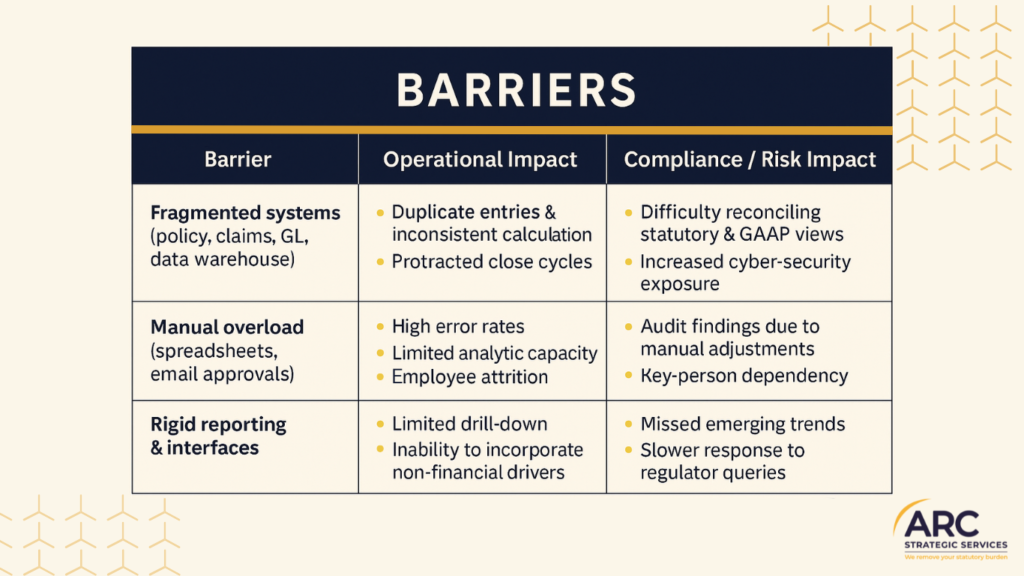
Siloed Data Architecture: Policy, claims, and general ledger systems don’t communicate. Each operates independently, forcing finance to manually reconcile and move data between platforms.
Manual Intervention at Scale: Spreadsheets become the workaround. Formulas are fragile, versioning is chaotic, and hidden dependencies create audit risk.
Inflexible Reporting: Legacy systems force reports into fixed formats. Ad hoc requests require new code, and business users cannot self-serve analysis.
Observation: The combination of siloed architecture and manual intervention prevents finance from delivering either fast regulatory submissions or strategic management reporting. When platforms can’t communicate, the organization loses both efficiency and visibility.
3 | The Cost of Inaction
Maintaining legacy processes imposes direct and indirect costs:
Slow Decision Cycles: Capital deployment, pricing, and reinsurance decisions stall while leaders wait for validated figures.
Hidden Expenses: Rework, overtime, and control failures quietly inflate overhead.
Talent Burnout: Professionals spend disproportionate time fixing data instead of analyzing performance. Competent staff don’t want to work in outdated technology.
Outcome: Over time, these factors depress return on equity and weaken an insurer’s ability to compete in data-intensive markets.
4 | Design Principles for a Data-Driven Finance Function
ARC Strategic Services recommends five design pillars to modernize finance operations:
Time and Resource Optimization
Automate reconciliations, allocations, and management reporting so finance staff focus on analysis and insight.
Data Confidence
Establish a governed data hub that feeds both statutory and management views, ensuring consistency across the organization.
Scalable Architecture
Select flexible platforms that accommodate new lines of business and regulatory changes without rework.
Cross-Functional Alignment
Automate underwriting, claims, and actuarial data flows for a single source of truth across the enterprise.
Efficient Implementation
Apply proven methodologies to cut transition risk, shorten payback, and ensure adoption.
Key Takeaway
Streamlined processes free finance to deliver insight instead of spreadsheets and reports.
5 | Why Engage a Specialist?
Successful transformation demands deep knowledge of insurance accounting, data governance, and change management. ARC Strategic Services combines decades of industry experience with specialized systems, insurance accounting, and process expertise to:
Current-State Diagnostics: Conduct diagnostics and quantify improvement opportunities without disrupting operations.
End-to-End Architecture: Design solutions covering ledger, sub-ledgers, BI, and workflow automation tailored to your business model.
Execution and Adoption: Manage data conversion, control design, and user adoption to minimize transition risk and accelerate value.
Ongoing Support: Provide outsourcing support for accounting, reporting, and compliance functions as you stabilize and grow.
Result: Finance shifts from a compliance-centric cost center to a strategic advisor, delivering real-time insight while meeting every statutory deadline.
Ready to Modernize Your Finance Environment?
For a confidential discussion about transforming your systems and processes, contact ARC Strategic Services today.
Contact: info@arcstrategicservices.com or (319) 451-0120